
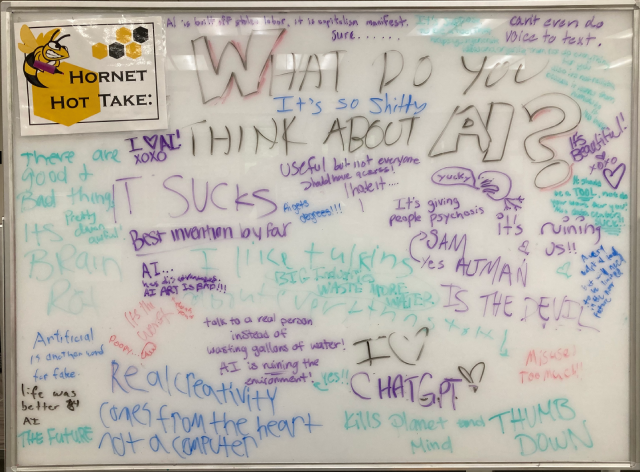
I got pulled in to doing work for the AI for Public Good grant that the nearby university is leading. The task given to me is to build a “comprehensive module for faculty that includes step-by-step guidance for incorporating AI into existing course assignments, along with supporting resources.” This should be interesting, since the sense I get is that faculty attitudes on the subject range from skeptical to hostile, and student feelings are largely negative as reflected in the scribblings above.
It seems that there is no shortage of this sort of material at this point, so we could just collate what’s out there. But I thought it would be good to start with a few ground rules:
- Students come first. We need to look out for their best interests. The tech industry (among others) will not.
- Reading and writing are foundational skills. Effective verbal and written communication skills are a necessity in all walks of life. These skills need to be developed and practiced repeatedly. There are no shortcuts.
- Metacognition matters. The best lesson we can impart to our students is how to learn, so they can monitor and take charge of their own learning throughout their lives and careers.
The first point should be a no-brainer, but it’s important to make it explicit. The second should resonate with faculty, whether they teach writing or not. But I think the last point is key. Skills in learning are at least as important as content knowledge. The intrusion of AI creates an opportunity to have that discussion.
I come at this from the perspective of an information literacy advocate, so I take the topic of metacognition as a pathway into a discussion of metaliteracy. I worry that the term may be too jargon-y to be relatable, but it does have a well-developed model, with learning objectives specifically mapped to the metacognitive learning domain. If I can map those to SUNY and institutional learning outcomes I may have something that is relatable.
In between starting and finishing this post, I came across Adam Neely’s latest video, They Teach AI Music at Music School Now…, where he points out that “It’s those fundamentals that have ultimately served me in my career.”
The fundamentals being ear training, music theory and technique — fundamentals of music. At my institution it’s more important to focus on fundamentals of learning, which are encoded in those ground rules. And maybe, if I can get people to refocus on information literacy as a fundamental learning skill, there will be some public good in this AI thing after all.