A friend of mine expressed willingness to display some of my artwork in his shop/event space, so I’ve been contemplating what I might have to say about the works. This has always challenged me. The work is strictly nonrepresentational, so it doesn’t lend itself to words all that well. Back when we used to discuss them in a group painting workshop, we used a lot of nonverbal communication – gestures and expressions. This worked because we were together enough to develop a common language. It wouldn’t with outsiders. I should also name them, which I have avoided for the most part so far.
Another challenge with talking about the work is that as the author, I’m a little too close to it. Conversely, some of the paintings were done decades ago, so I feel too distant from what ever headspace I was in at the time.
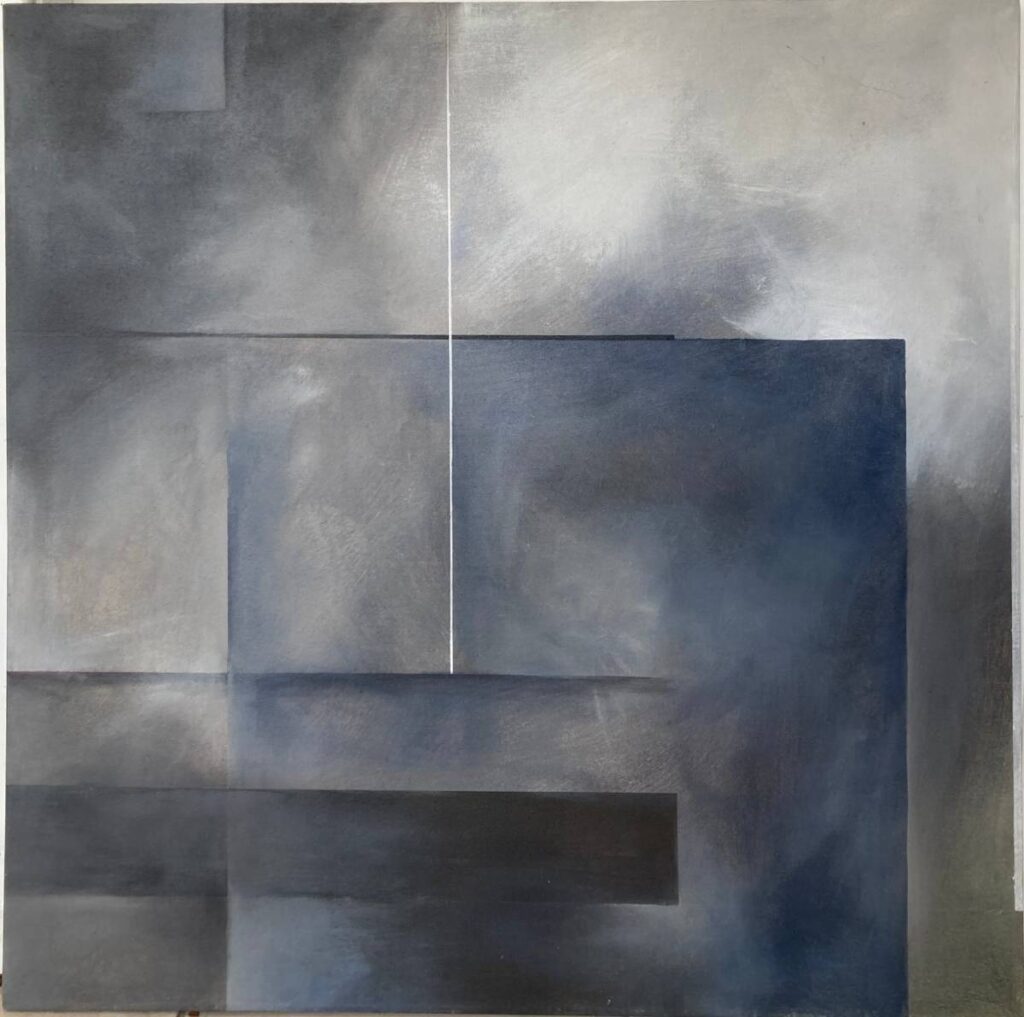
I wondered what might happen if I tried to use AI as an interlocutor. My expectation is that it would fail miserably, being the optimist that I am. So I instructed Gemini to “Give me a creative analysis of this image” for a few paintings. Here is its response:
This piece feels like a conversation between order and chaos. It has the atmospheric mood of a rainy city at midnight—equal parts architectural and ethereal.
Here is a creative breakdown of what’s happening on that canvas:
- The Fog of the Unconscious
The background isn’t static; it’s a restless, smoky gradient of steel blues and misty greys. This creates a sense of liminal space—that “in-between” feeling you get in a deserted airport or a foggy harbor. It suggests a landscape that hasn’t fully formed yet, or perhaps a memory that is starting to fade.
- The Geometry of Logic
The sharp, rectangular overlays act as the “bones” of the image. While the background is fluid and messy, these shapes are disciplined. They look like:
- Blueprints for a building that will never be finished.
- Viewports or windows looking out into a storm.
- Layers of digital data overlapping a physical world.
- The Anchor: The White Vertical
The most striking element is that singular, thin white line slicing through the center. It serves several purposes:
- The Plumb Line: It provides a sense of gravity in a piece that otherwise feels like it’s floating.
- The “Zip”: Reminiscent of Barnett Newman’s work, it creates a focal point that demands the eye stop searching and just be present.
- The Spark: It’s the only pure “light” in the composition, acting like a lightning bolt frozen in time or a single thread of clarity in a confusing situation.
- The “Weight” of the Bottom
The dark, heavy horizontal bars at the bottom left give the painting a “base.” Without them, the image might feel too light or ghostly. These dark blocks feel industrial—like iron beams or the shadows of a pier—grounding the viewer so they don’t get lost in the clouds above.
The “Vibe” Summary
If this painting were a sound, it would be a low cello note sustained for a long time, or the muffled hum of a city heard from a high-rise balcony. It’s sophisticated, slightly melancholic, but deeply steady.
I guess that thing they say about AI and em dashes is true. I count four. The writeup inspired a potential title – psychetecture – that I’m borrowing from Mister X. It connects intuitively, but I doubt I could explain it with any clarity.
I also asked Claude for a critical analysis of a few works. This was interesting in that it seemed perceptive, identifying issues of uncertainty and incompleteness that I recognize myself. When asked what the artist is trying to say across multiple works, it gave me this:
Across all three, there’s a politeness, a hesitation to fully commit to either chaos or order. The artist gestures toward emotional intensity but pulls back from genuine rawness. We see sadness but not despair, warmth but not passion, movement but not violence.
I actually feel seen. For the most part though, I see a very AI voice in the AI output. It makes me think, “You’re talking alot, but you’re not saying anything.” One could say the same about my work I suppose. That quote comes from the lyrics to Psycho Killer, which feels appropriate.
But at least I’m polite.